Anúncios
At the intersection between human genius and the colossal power of machines, a universe of new possibilities is born — but also ethical dilemmas, silent risks, and radical transformations. When our creative dreams merge with computational power, incredible innovations emerge, automation reshapes markets, and yes, digital threats grow ever smarter.
This article explores this powerful encounter: from the first computer viruses — technical curiosities that simply wanted to say “I’m the creeper: catch me if you can!” — to today’s sophisticated cyberattacks and AI systems that almost think for themselves. It’s a humanized look, full of curiosity and awareness: after all, it is we who drive and define the path of this union between creativity and machines.
🧠 Human creativity: the spark that ignites the circuits
The pursuit of innovation is at the core of being human. From inventing the wheel to algorithms that anticipate behaviors, our creativity has always been the starting point. In computing, this spark began with small experimental ideas — little programs that demanded attention, like Creeper, or algorithms to play electronic notes.
Anúncios
These initiatives, although simple, reveal something important: every line of code reflects human thought. A playful program that moves between systems, a repetitive routine to save time, a rendered image for entertainment. Before terms like “artificial intelligence” existed, there was technical curiosity and the desire to experiment.
And it was in this space of play and discovery that the power of machines began to manifest: not only as tools, but as extensions of our creativity.
Anúncios
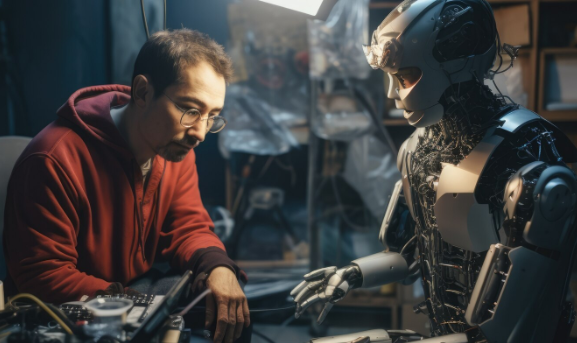
🤖 Intelligent machines: beyond instructions, autonomy, and learning
With advances in processing power, algorithms capable of learning, adapting, and, in a way, surprising their own creators began to appear. Artificial intelligence (AI) systems evolved — from simple fixed rules to deep neural networks, machine learning, and finally autonomous learning.
This transformation represents a monumental leap: machines that can recognize faces, translate languages in real time, diagnose diseases, compose music, or generate stunning images — all on their own. These systems capture the essence of human creativity and systematically reinvent it with efficiency, speed, and scale.
At this point, the human-machine relationship moves from operational to symbiotic: we create mechanisms that learn to operate beyond our capacity — and often do it better.
💥 When creativity meets vulnerabilities: the evolution of viruses
It’s important to remember that human creativity does not fuel only benign innovations. It also drives computer viruses, from their most harmless forms to today’s sophisticated attacks.
In the beginning, Creeper was just a proof of concept, without malice. Then came programs like Brain or ILOVEYOU — still simple but with the potential to cause real damage. Later came modern malware: ransomware that locks files, trojans that spy remotely, spyware that steals personal and political data.
Today, machines empower both attack and defense. Algorithms detect suspicious patterns in real time, AI identifies intrusion attempts, and automatic defenses block unauthorized access. But virus creators also use AI — to generate personalized phishing, break advanced passwords, or hide malware in almost undetectable code.
The result is a creative race: hackers and security experts compete for technological dominance. Human creativity, in this battle, expresses itself both in construction and destruction — and machines amplify these potentials.
🎨 Art and algorithms: new forms of creative expression
Another fascinating field where this fusion happens is art. Computational power not only accelerates creative processes but expands what is possible to imagine.
There are algorithms that compose music based on the styles of Bach or Beethoven, generate poems with simulated emotion, create photorealistic images of nonexistent scenes, or even write movie scripts based on narrative patterns. Artists collaborate with machines to co-create surprising visual and sonic works.
This partnership reflects something essential: machines can learn, replicate, remix — but the original inspiration still comes from humans. Machines amplify, accelerate, or reshape, but creativity pulses from human ideas.
🌐 Transforming business, convenience, and everyday life
When creativity meets scalable machine power, the impact spreads to the economy, services, and daily life. AI-based apps help diagnose diseases with greater accuracy. Virtual assistants offer 24/7 support. Self-driving cars are on the streets. Logistics are optimized by algorithms planning routes and inventories. Finance is automated with trading robots.
It’s almost magical: human errors are reduced, speed and efficiency skyrocket, and experiences become personalized at a global scale. All this stems from the union of an ingenious idea and computational capability — combined with data, networks, and continuous learning.
⚖️ Ethical dilemmas: when creativity crosses boundaries
Not everything that can be done should be done. The union of human creativity and machine power brings real dilemmas:
-
Privacy: digital tracking, facial recognition, and personal data sharing.
-
Transparency: opaque decision-making algorithms affecting lives without clear explanations.
-
Inequality: automation eliminating jobs without creating equivalent opportunities.
-
Autonomy: to what extent should automated systems make decisions without human oversight?
These questions require ethical reflection, intelligent regulation, and ongoing dialogue — to ensure innovation doesn’t sacrifice fundamental human values.
🔄 A hybrid future: collaboration, responsibility, and new horizons
Looking ahead, we see a fascinating landscape — where humans and machines collaborate more closely. Robotic surgeons assist doctors, creative algorithms help screenwriters, AI educates children with personalized methods, and agricultural drones monitor crops with millimeter precision.
In this hybrid future, human creativity remains essential — to set directions, measure impacts, and protect the values that sustain our societies. Machines can be powerful, but they lack will or ethical consciousness. To make their use truly beneficial, we must keep human protagonism.
✨ Conclusion: the alliance that defines tomorrow
When human creativity meets the power of machines, something extraordinary happens. An era is born where imagination can materialize in fractions of a second, ideas replicate globally, and the world can be transformed — for better or worse.
Unrestrained power without ethics, control, or empathy can generate inequalities, invisible threats, or dangerous dependencies. On the other hand, a balanced combination — guided by purpose, respect, and awareness — has the potential to solve global crises, expand opportunities, and enrich lives.
Ultimately, this encounter is not only technological: it is philosophical, cultural, and deeply human. And the future will surely be written at this vibrant intersection — between the creative mind and the power of machines.