Anúncios
Introduction: Why DLSS Matters in the Future of Gaming and AI
In an industry constantly pushing the limits of realism and performance, NVIDIA’s Deep Learning Super Sampling (DLSS) has emerged as a groundbreaking technology transforming gaming, professional rendering, and AI integration. DLSS utilizes the power of artificial intelligence to deliver higher frame rates while maintaining, and sometimes enhancing, visual quality.
Anúncios
For gamers, this means smoother gameplay without sacrificing resolution. For professionals, it means rendering high-fidelity scenes faster and with less hardware strain. For the broader tech landscape, DLSS is a practical demonstration of AI’s potential in real-world, consumer-facing applications. Understanding DLSS is not just about gaming; it’s about how AI is reshaping what your GPU can do.
Anúncios
This article will guide you through:
-
What DLSS is and how it works.
-
The technology and AI models powering it.
-
Real-world benefits for gaming and rendering.
-
DLSS versions and their improvements.
-
Challenges and limitations.
-
The future of DLSS and AI integration in NVIDIA’s ecosystem.
Section 1: What is DLSS?
1.1 Definition
DLSS (Deep Learning Super Sampling) is NVIDIA’s AI-powered upscaling technology that enables:
-
Lower-resolution images to be rendered.
-
AI-driven upscaling to higher resolutions.
-
Preservation of image quality with improved performance.
It allows a game to render internally at a lower resolution (e.g., 1080p) and upscale it to a higher target resolution (e.g., 4K), reducing the GPU workload while maintaining sharp visuals.
1.2 Why It Matters
Before DLSS, achieving high frame rates at 4K required top-tier GPUs, limiting accessibility. DLSS makes high-resolution gaming more accessible to a wider audience without requiring expensive hardware upgrades, representing a practical, eco-friendly use of AI in everyday tech.
Section 2: The Technology Behind DLSS
2.1 Neural Networks and Supervised Learning
DLSS uses deep neural networks trained on:
-
High-resolution images.
-
Corresponding low-resolution inputs.
These networks learn how to predict and reconstruct missing details in low-res images, enabling AI-driven image reconstruction that maintains fine details.
2.2 Tensor Cores and AI Processing
NVIDIA’s RTX GPUs feature Tensor Cores—specialized hardware designed for AI operations. Tensor Cores perform the matrix calculations required by deep learning models efficiently, making real-time inference possible while gaming.
2.3 The Supercomputer Training Pipeline
Training DLSS involves:
-
Using NVIDIA’s supercomputers to render games at ultra-high resolutions.
-
Downsampling these images to lower resolutions.
-
Training the neural network to predict high-quality frames from lower-resolution inputs.
This offline training pipeline allows DLSS to infer high-quality frames in real time during gameplay using the trained neural network.
Section 3: Versions of DLSS
DLSS has evolved significantly since its launch:
3.1 DLSS 1.0
-
Method: Used spatial upscaling with a convolutional neural network.
-
Limitations: Visual artifacts and blurriness in certain scenarios.
-
Adoption: Limited due to image quality inconsistencies across games.
3.2 DLSS 2.0
-
Method: Moved to a temporal feedback approach using multiple frames to enhance prediction accuracy.
-
Advantages:
-
Sharper images.
-
Better performance across various resolutions.
-
One generalized AI model for all games, reducing per-game training requirements.
-
3.3 DLSS 3.0
-
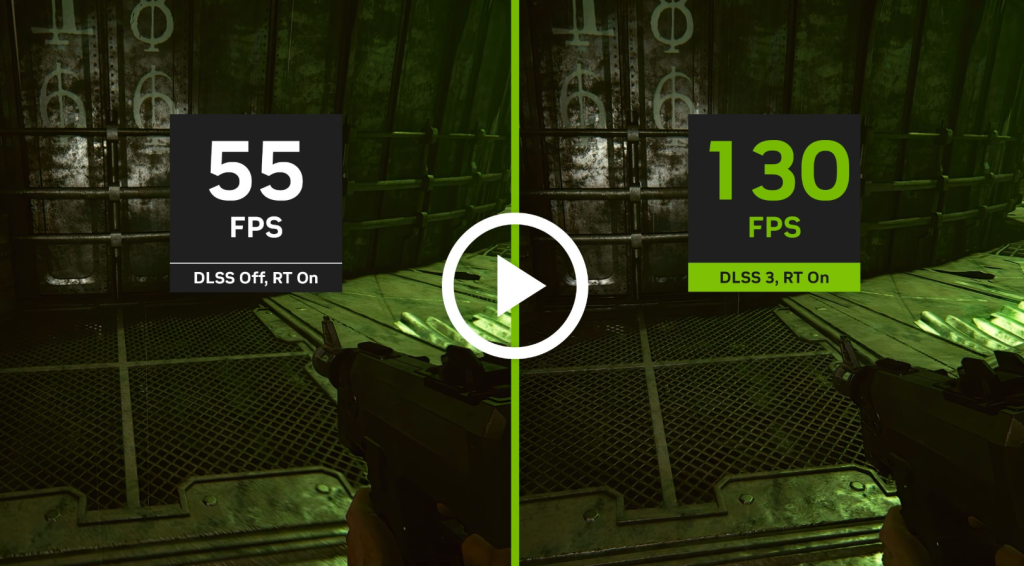
Introduced Frame Generation, creating entirely new intermediate frames using AI.
-
Combines super-resolution with AI-generated frames to nearly double frame rates in supported titles.
-
Requires NVIDIA RTX 40-series GPUs to utilize Frame Generation features fully.
Section 4: Benefits of DLSS for Gamers and Professionals
4.1 Higher Frame Rates
DLSS enables smoother gameplay without compromising resolution or visual quality, crucial for:
-
Fast-paced competitive games.
-
Open-world AAA titles requiring high processing power.
4.2 Reduced Hardware Strain
By rendering at lower internal resolutions, GPUs:
-
Consume less power.
-
Generate less heat.
-
Deliver high performance on mid-range hardware.
This extends the lifespan of gaming systems and reduces the environmental impact of heavy computing.
4.3 Enhanced Visual Fidelity
DLSS 2.0 and above often deliver images indistinguishable from, or sharper than, native resolution due to AI-based reconstruction.
4.4 Accessibility
DLSS allows gamers with lower-tier hardware to experience high-fidelity gaming, democratizing access to high-performance gaming experiences.
4.5 Professional Applications
In professional visualization, DLSS can:
-
Speed up rendering in applications like Unreal Engine and D5 Render.
-
Allow faster iteration in design and architectural visualization.
-
Enable real-time high-fidelity previews for artists and designers.
Section 5: Real-World Examples of DLSS in Action
| Game/Application | Benefits with DLSS |
|---|---|
| Cyberpunk 2077 | 4K gaming at playable frame rates with ray tracing enabled |
| Control | Smooth gameplay with ray tracing on mid-tier RTX GPUs |
| Microsoft Flight Simulator | Improved frame rates while maintaining terrain detail |
| Unreal Engine | Faster high-res previews during game development |
| D5 Render | Real-time architectural visualization with less hardware strain |
Section 6: Challenges and Limitations of DLSS
6.1 Compatibility
DLSS requires:
-
Supported games with DLSS integration.
-
NVIDIA RTX GPUs (with Tensor Cores).
-
Game developers to implement DLSS SDK in their titles.
6.2 Artifacts and Ghosting
Although improved with newer versions, some users may notice:
-
Ghosting in high-motion scenes.
-
Occasional artifacts, especially in earlier DLSS versions.
6.3 Hardware Requirements for Frame Generation
DLSS 3.0’s Frame Generation requires RTX 40-series GPUs, limiting this feature to users with the latest hardware.
6.4 Competition with Other Upscaling Technologies
DLSS competes with:
-
AMD’s FSR (FidelityFX Super Resolution), which is hardware-agnostic.
-
Intel’s XeSS.
While DLSS often provides superior quality, its hardware lock to NVIDIA GPUs is a limitation for users across platforms.
Section 7: DLSS and AI Integration at NVIDIA
7.1 NVIDIA’s AI Ecosystem
DLSS is part of NVIDIA’s broader AI strategy, which includes:
-
AI research in deep learning and computer vision.
-
AI tools for professional visualization and healthcare.
-
Self-driving car technology using AI inference on GPUs.
7.2 The Role of Tensor Cores
NVIDIA’s investment in Tensor Cores has enabled:
-
Real-time AI processing during gaming.
-
Advancements in AI rendering pipelines.
-
Efficient use of AI models for gaming, design, and AI research.
7.3 DLSS as a Proof of AI’s Power
DLSS is a practical example of how AI can solve real consumer problems while enhancing user experience, demonstrating the potential for AI across industries.
Section 8: The Future of DLSS and AI in Gaming
8.1 Potential DLSS Improvements
Future iterations of DLSS may:
-
Further reduce artifacts and improve motion clarity.
-
Support wider game adoption through SDK refinements.
-
Integrate with VR to enable high-resolution, high-frame-rate experiences with lower hardware requirements.
8.2 Broader AI-Driven Rendering
NVIDIA’s long-term vision includes:
-
AI-assisted global illumination.
-
AI-powered texture and asset generation.
-
Full-scene AI rendering to enable photorealistic graphics on consumer hardware.
8.3 Democratizing High-Fidelity Experiences
As DLSS improves, more gamers with varying budgets will access high-quality graphics, reducing the gap between high-end and mid-range gaming experiences.
Section 9: Table – DLSS Versions Comparison
| Version | Key Features | Limitations |
|---|---|---|
| DLSS 1.0 | Spatial upscaling using AI | Blurriness, artifacts, per-game training |
| DLSS 2.0 | Temporal feedback, generalized model | Minor ghosting in some cases |
| DLSS 3.0 | Frame Generation, high fps boost | Requires RTX 40-series GPUs |
Conclusion: DLSS as a Milestone in AI and Graphics Integration
DLSS represents a revolutionary shift in how artificial intelligence intersects with graphics rendering, offering:
-
Practical solutions for smoother gaming.
-
Accessibility to high-fidelity experiences on mid-range hardware.
-
A demonstration of AI’s ability to improve consumer technology tangibly.
NVIDIA’s commitment to AI integration through DLSS and Tensor Core innovations ensures that the future of gaming, visualization, and even professional rendering will continue to benefit from AI advancements.
DLSS is not just a feature; it is a testament to the evolving landscape where AI moves from research labs into the daily lives of consumers, shaping how we experience digital worlds.